
The NAD+ researcher who doesn't take NAD+
Eric Verdin leads the Buck Institute for Research on Aging, has been studying NAD+ for over 20 years — and has stopped his NMN supplementation. These three facts together say more about the current state of NAD+ science than most marketing claims.
Two camps, both incomplete
The public discourse on NAD+ is divided. On one side stand longevity enthusiasts who market NAD+ as a universally effective optimisation molecule — including expensive infusions. On the other side are the total sceptics, who dismiss any engagement with NAD+ precursors as pseudoscience.
Verdin belongs to neither camp. His position is nuanced, evidence-based, and precisely for that reason relevant to practitioners: it offers a frame of reference that is neither hype nor reflexive dismissal.
What Verdin specifically criticises
Intravenous and intramuscular NAD+ administration
Verdin is unambiguous: infusions are not a sensible route of administration. The compound does not reach cells effectively via this pathway. At the same time, patients regularly report side effects including nausea, flushing, and dizziness. The ratio of effort, cost, and demonstrated benefit is not justifiable.
Blind supplementation without a data basis
Of the dozens of supplements marketed in the longevity space, very few have a demonstrated effect — according to Verdin's assessment. His principle applies universally, not only to NAD+: first test whether a deficiency exists. Then intervene in a targeted way. He recommends the same principle for vitamin D, B12, and omega-3.
His own example as an argument
Verdin discontinued NMN after observing a rise in his own homocysteine levels. The mechanism is well understood: excess nicotinamide is broken down via methylation processes, consuming methyl groups in the process. Elevated homocysteine is associated with cognitive decline. A supplement widely regarded as harmless can have adverse individual effects — through a pathway that remains invisible without measurement.
What Verdin defends: the biology is real
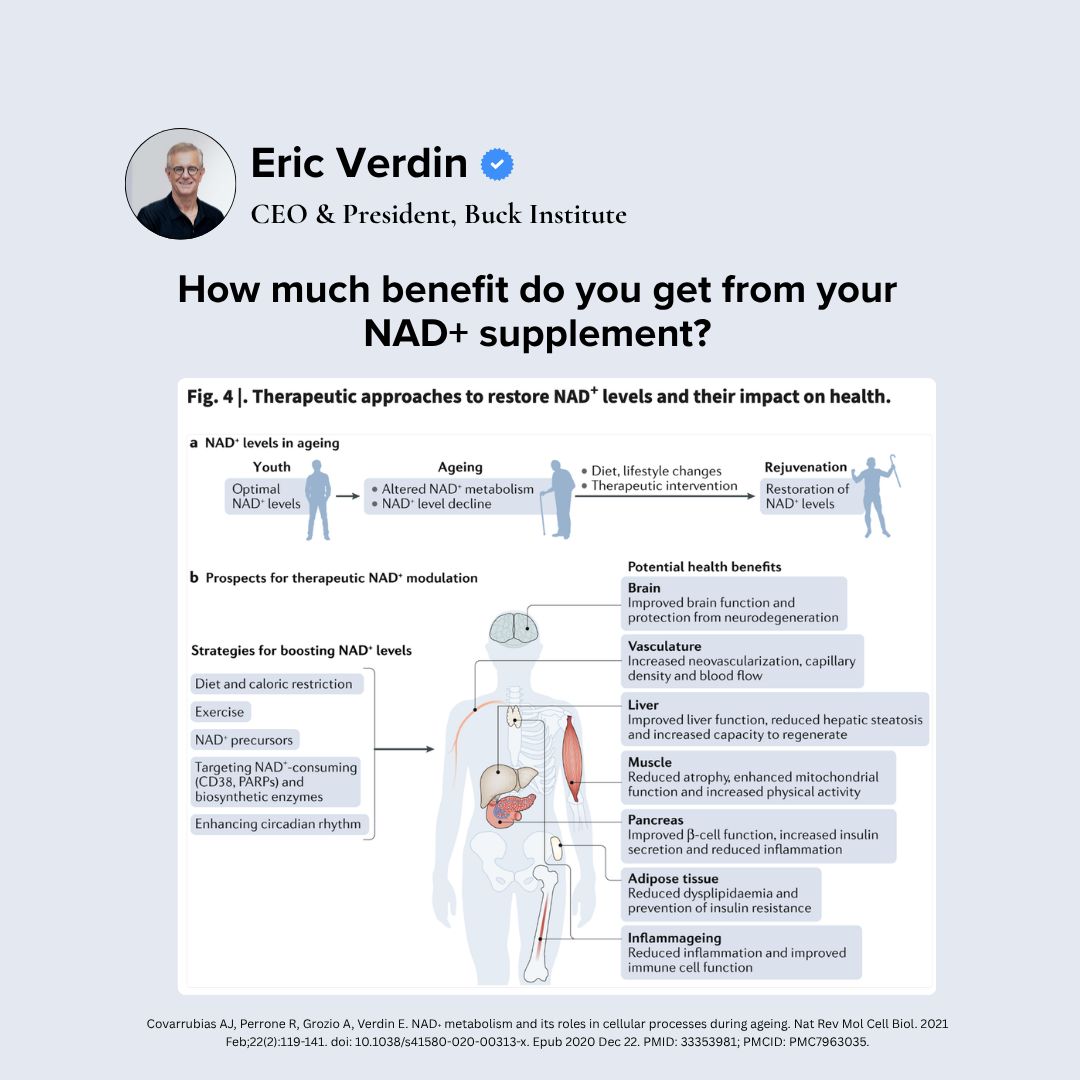
Despite this criticism, Verdin is not an opponent of NAD+. The review paper from his team in Nature Reviews Molecular Cell Biology shows how many systems NAD+ potentially acts across: brain, vasculature, liver, muscle, pancreas, adipose tissue, and the chronic inflammatory processes of ageing. The word "potentially" is decisive here — the majority of the evidence comes from animal and cell models.
What the data concretely offers practitioners:
- NAD+ precursors such as NR have been rated as safe in studies at up to 2,000 mg daily for periods of up to 20 weeks.
- In certain conditions — including Parkinson's disease and rare DNA repair disorders — there are genuine clinical signals.
- The age-related decline in NAD+ is tissue-dependent: it is documented in skin, liver, and brain, in some cases by up to 80 percent. Other tissues show no comparable decrease.
This tissue-dependence is precisely what explains why human studies on NAD+ produce such varied results: they measure different populations with different baseline values.
The actual point: deficiency before intervention
Verdin's key statement is unspectacular — and clinically relevant for exactly that reason:
The decisive factor for the efficacy of NAD+ supplementation is whether the individual actually has a deficiency in the first place.
This statement closes the loop with an earlier article on this blog: if blood NAD+ does not reliably decline with age and the deficiency varies by tissue and individual, the clinically meaningful question is never "NAD+ yes or no?" — it is always: for this person, on the basis of this data.
What this means in practice
Viewing NAD+ status in isolation is insufficient
Verdin's NMN example shows that an intervention at one point in metabolism can create costs elsewhere. NAD+ status, homocysteine, B vitamins, and inflammatory markers belong together — not assessed sequentially, but as a connected data picture.
Testing before intervening is not a luxury, it is methodology
Practitioners who advise clients to take NAD+ precursors without knowing their baseline status are working against their own expertise. Those who begin with measurement can differentiate: who benefits from supplementation? Who already shows adequate levels? Who presents with accompanying findings that complicate an intervention?
The SLOW approach: holistic and precise
On the SLOW platform, health professionals translate exactly these data layers into a decision that fits the individual. NAD+-related markers are not evaluated in isolation, but in the context of a complete biomarker profile — including methylation status, inflammatory parameters, and further longevity-relevant values. This is not overengineering. It is the methodology Verdin himself describes: measure first, then decide.
From data to results — not as a promise, but as a way of working.
Summary: what practitioners take from the Verdin position
Statement Implication for practice Infusions are not a sensible route of administration Actively advise clients against expensive, unsubstantiated applications Blind supplementation is not a strategy Measure NAD+ status before making a recommendation Homocysteine rise under NMN is real Include methylation status and B vitamins in the assessment NAD+ decline is tissue-dependent Blood NAD+ alone is not a sufficient decision parameter Certain conditions show genuine signals Indication-based supplementation is justifiable — blanket supplementation is notSources
- Covarrubias AJ, Perrone R, Grozio A, Verdin E. NAD+ metabolism and its roles in cellular processes during ageing. Nat Rev Mol Cell Biol, 22, 119–141 (2021).
- Bohr VA. Promising Results With NAD Supplementation in Rare Diseases. Aging Cell (2025).
Do you use NAD+ status measurements in practice — and how do you distinguish clients who benefit from supplementation from those who don't? Write it in the comments.